Monday, January 31, 2011

Active Japanese Volcano Forces Residents to Flee

Interestingly, there are five volcanos on Kyushu, but this article doesn't identify which one is erupting!

Aira Caldera
Mount Aso
Kaimondaki
Sakurajima
Mount Unzen


NTD Television: Active Japanese Volcano Forces Residents to Flee

Residents on Japan's southern island of Kyushu were urged to evacuate Monday after a volcano spewed out more hot ash for the sixth day.

An evacuation advisory issued late Sunday night kept the alert level at three, but expanded the off-limit area to about two miles or three kilometers.

[Yukio Edano, Chief Cabinet Secretary]:
"There are concerns that streams of heated rocks and volcanic ash may reach up to a three-kilometer radius when an explosive eruption occurs."

As a result, more than one thousand people in the town of Takaharu, located at the foot of the volcano, were forced to stay at nearby gymnasiums and community centers.

Residents are worried about an impending eruption.

[Evacuee]:
"There was a large rattle on the roof which made me very scared, so I fled here."

[Evacuee]:
"The real problems are yet to come. I'm really worried about how long it will last."

There has been no report of injuries, but reports say some farms have been affected by thick layers of ash.

Two of the four schools here are still open, but students have to be driven to school and wear facial masks for protection.

[School Teacher]:
"Safety is the number one priority for everyone today. First of all, nobody is allowed to go outside. No playing in the playground today."

A Japanese meteorological official says the last time this volcano showed similar levels of activity was three centuries ago.

U.S. Begins Evacuation Flights From Cairo


CAIRO — The State Department began a voluntary evacuation of hundreds of American citizens from Egypt on specially chartered flights to “safe havens” on Monday as unrest continued to roil the country.

Cairo International Airport on Monday was a chaotic scene, overflowing with tourists and Egyptians desperate to get on an outbound commercial flight. Outside Terminal 1 more than 1,000 people — mostly Egyptians — sat on sidewalks and in the airport parking lot, surrounded by luggage.

Tempers boiled over at times as travelers struggled to get seats on the limited number of commercial flights still operating. At one point the airport stopped posting flight times on its departure board, The Associated Press reported, in an attempt to ease tensions. But the move served only to stoke anger over delays and cancellations.

Friday, January 21, 2011

Two reported shot dead as protests erupt in Albania


Two reported shot dead as protests erupt in Albania
TIRANA (Reuters) – Two people were reported shot dead as protesters fought police outside Albanian Prime Minister Sali Berisha's office on Friday during a rally to demand the government resign over corruption allegations.

"We have two dead civilians. The signs show they were shot from close range with a small caliber pistol. They were dead when they came here," Sami Koceku, a surgeon at Tirana's Military Hospital, told Albanian television.

There were large bloodstains on the road and police said several of its officers had been injured.

Supporters of the opposition Socialist Party had earlier rallied outside the prime minister's office and some had pelted the building and police with stones, sticks and umbrellas.

Police responded with tear gas, rubber bullets, water cannon and stun grenades. Smoke billowed from burning cars, some of them police vehicles.

The length of the main boulevard was packed with protesters, and witnesses said the crowd numbered around 20,000. Some chanted "Victory" and "He's gone." Police warned the crowd not to enter the government building but a few ventured inside.

After some three hours of clashes police in riot gear dispersed the crowd and took control of the boulevard. Live television pictures showed police chasing stray lone protesters and beating them with truncheons.

Berisha, who had been due to visit a town in northern Albania on Friday afternoon, had no immediate comment. A few hours after the unrest his staff said he was in his office and would talk to reporters at 1830 GMT.

The border between the US and Canada

Can you name the northern states that border the US and Canada.

Consulting my handy-dandy globe:

From West to East:
Washinton State
Idaho
Montana
North Dakota
Minnesota
Michigan
New York
Vermont
Maryland
Maine

Now, what Canadian provinces do they border?

Washington State, Idaho and a bit of Montana border British Columbia.

Montana also borders Alberta.

Montana also borders Saskatchewan, as does North Dakota.

North Dakota also borders Manitoba.

Minnesota borders a bit of Manitoba and a bit of Ontario.

Wisconsin doesn't border Ontario, although it does border some of the Great Lakes: Superior and Lake Michigan.

Michigan also borders these great lakes, as well Ontario.

New York borders a bit of Ontario and a bit of Quebec.

Vermont, New Hampshire, and Maine also border Quebec.

Maine also borders New Brunswick.

Future posts will cover each state at a time. Take a look at your globe (you do have a globe, don't you???) or atlas to get an idea in your mind of the provinces and states.

Thursday, January 20, 2011

Georgia starts new wave of refugee evictions


Just what is Georgia?
Georgia is a sovereign state in the Caucasus region of Eurasia. Situated at the juncture of Eastern Europe and Western Asia, it is bounded to the west by the Black Sea, to the north by Russia, to the southwest by Turkey, to the south by Armenia, and to the southeast by Azerbaijan. Georgia covers a territory of 69,700 km² and its population is almost 4.5 million. Georgia's constitution is that of a representative democracy, organized as a unitary, semi-presidential republic. It is currently a member of the United Nations, the Council of Europe, the World Trade Organization, the Organization of the Black Sea Economic Cooperation, the Organization for Security and Cooperation in Europe, the Community of Democratic Choice, the GUAM Organization for Democracy and Economic Development, and the Asian Development Bank. The country aspires to join NATO and the European Union.


TBILISI (Reuters) – Georgia on Thursday embarked on a new wave of evictions of hundreds of people displaced by war from state-owned buildings the government hopes to privatize.

The evictions, which started in August, reflect an effort to tackle a massive refugee problem stemming from conflicts in the early 1990s in the rebel Abkhazia and South Ossetia regions and again in 2008 when Russia and Georgia fought a five-day war.

The Georgian government says there are around 1,500 Internally Displaced Persons (IDPs) who need be resettled.

But the IDPs to be evicted reject alternative accommodation in rural areas close to rebel regions, saying that resettlement there would leave them without sources of income and new housing options lack livelihood opportunities.

Police sealed off a temporary refugee shelter in the outskirts of the capital Tbilisi on Thursday and detained several activists who were trying to block the way of trucks and buses taking IDPs to villages.

"Georgia might be the only country in the world that has a ministry for refugees. This ministry has been created to destroy and humiliate the Georgian people," Malkhaz Kordzaia, a refugee from Abkhazia, told reporters at the scene.

Those from Abkhazia have lived in Tbilisi and its outskirts -- many in old hospitals, barracks, institutes and kindergartens -- for 17 years after over 200,000 fled the rebel Black Sea region as it threw off Georgian rule with the collapse of the Soviet Union.

There have been a series of small street rallies in the past few weeks protesting against expected evictions.

Some opposition activists arrived at the scene of evictions on Thursday, promising more protests.

"We will fight with every drop of our blood against this government," opposition activist Kakha Kukava said.

Georgia's Ministry for IDPs from Occupied Territories, Accommodation and Refugees rejected the criticism.

"These buildings were occupied illegally ... All IDPs were warned in advance and will move to new houses," said ministry chief administrator Valery Kopaleishvili.

According to the ministry, about 10,000 families displaced from Abkhazia in the early 1990s were granted houses in Tbilisi but there were not enough resources in the capital to provide everyone with dwelling space.

The United Nations refugee agency (UNHCR) expressed concern last summer that the evictions "have not been undertaken with the necessary transparency or circulation of information," but said progress was being made to improve procedures.

Saturday, January 15, 2011

15 Jan, 2011, Sat, South Sudan ends independence vote, awaits statehood


The whole of Sudan. Note the countries surrounding it.


South Sudan. The part of the country with all the oil.


South Sudan ends independence vote, awaits statehood
JUBA, Sudan (Reuters) – South Sudan's polling centers closed their doors on Saturday after a week-long vote on independence from the north that could end a vicious cycle of civil war with the creation of the world's newest state.

Former President Jimmy Carter, leading a mission observing the vote, said turnout could reach 90 percent and that it seemed likely the south had voted for independence.

Exhausted polling staff processed a straggle of voters on the final day in the southern capital Juba. Some officials were so tired they were sleeping behind their dusty stalls.

"I feel relieved as this is what we've been fighting for 21 years," said southerner Ayen Deng. "We're waiting for the official results but we will be celebrating tonight."

Final results are due before February 15 but could be announced as early as the beginning of next month. "Of course there will be independence, we can smell it," said Santino Riek.

The vote caps a 2005 peace agreement that ended decades of civil war between the mostly Muslim north and the south, where most follow Christianity and traditional beliefs.

Northern officials have appeared increasingly resigned to losing the oil-producing south -- which makes up a quarter of the country's land -- allaying fears conflict could reignite.

HIGH TURNOUT

Carter, leading one of the largest observation missions, told reporters in Khartoum a handful of centers had reported 100 percent turnout and were already tallying the results.

"We already know that in the south there's been about an average of 90 percent (participation) from the stations we've observed and I think they are representative," Carter said.

In the few centers where he had seen counting under way, he said, the votes "were practically unanimous in favor of separation with only a few ballots to the contrary.

"It's highly likely that the referendum result will be in favor of separation," Carter said, but added that no one should prejudge the outcome.

At least 60 percent of registered voters needed to take part for the result to be binding. That point was reached just four days into the vote, according to the organizing commission.

Carter also said the vote had probably met international standards and Khartoum said it would recognize the result, meaning all southerners must do now is wait to celebrate their independence day, likely on July 9.

The former U.S. president played down threats of popular protests in the north following the vote.

"My hope is that the opposition parties in the north will be brought into consultations with President (Omar Hassan al-) Bashir's party and that they will prepare for modifications for the constitution," he said.

Students clashed with police in Khartoum and two northern towns on Wednesday and Thursday in protests over rising prices, part of an economic crisis that has been exacerbated by fears of the impact of losing the south.

Southern independence campaigners have described the vote as a chance to throw off decades of perceived northern repression.

Bashir said in a speech in Khartoum state that neither the north nor Muslims had ever oppressed the south, but rather the divisions were the legacy of the ex-colonial power, Britain.

"The south has been a burden on Sudan from independence until today," he said on state television.

More than 182,000 exiled southerners have returned to the south since the end of October, according to U.N. figures, many of them fearing repercussions in the north after the vote.

South Sudan's government believes that figure could rise to as much as half a million by the beginning of July, said the U.N.'s deputy humanitarian coordinator in Sudan, Lise Grande.

"Services are already overstretched. With more people coming back there will be tremendous pressures on agencies," she said.

Friday, January 14, 2011

Tunisian President Leaves Country Amid Unrest


Voice of America: Tunisian President Leaves Country Amid Unrest
Tunisian President Zine El Abidine Ben Ali has left the country, amid the worst unrest there in decades. The Arabic language network al-Jazeera says the speaker of parliament is temporarily in charge.

The president was reported to have boarded a flight out of the country Friday evening local time. The military had sealed off the airport and closed Tunisian airspace a short time beforehand.

A state of emergency was also declared earlier Friday, with public gatherings banned and security forces authorized to shoot violators.

Dozens of people have been killed in rioting over unemployment and high food prices, with many protesters demanding Mr. Ben Ali resign. The exact death toll is not clear.

The president had earlier dismissed his government and called for early elections.

Police fired tear gas at protesters in the capital Tunis, and reporters saw officers beating and chasing demonstrators. Witnesses also said shots were heard Friday near the interior ministry.

Hospital officials said 13 people were killed late Thursday - the same day that President Ben Ali announced concessions to try to stop deadly riots.

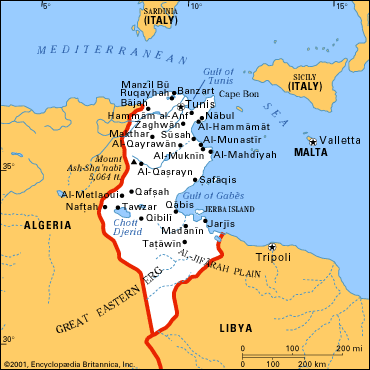
About Tunis
Tunisia, officially the Tunisian Republic (al-Jumhūriyya at-Tūnisiyya), is the northernmost country in Africa. It is a Maghreb country and is bordered by Algeria to the west, Libya to the southeast, and the Mediterranean Sea to the north and east. Its area is almost 165,000 km², with an estimated population of just over 10.3 million. Its name is derived from the capital Tunis located in the north-east.

A Maghreb country refers generally to five countries located in North Africa, although it is most commonly used for French North Africa (Algeria, Morocco and Tunisia). It is an Arabic word, literally meaning "place of sunset" or "the west" (from an Arabian perspective). The term is generally now used, mainly by Arabs, to refer collectively to the African countries of:

Morocco
Algeria
Tunisia
Libya
Mauritania
and the disputed territory of Western Sahara.

However, before the establishment of modern nation states in the region in the 20th century, "Maghreb" signified the smaller area that lies between the high ranges of the Atlas Mountains in the south, and the Mediterranean Sea in the north, thus excluding most of Libya and all of current Mauritania. Sometimes, after Islam entered the region, the term has included the previously Muslim Andalusia, Sicily, and Malta.