
Monday, March 14, 2011
Japan's Fukushima Daichi nuclear plant
On the left you can see where the plant is, several miles above Tokyo. It actually looks to be quite close to Misawa, a relatively small city that is home to a US Air Base. I've been there...


Gulf security forces enter Bahrain, in response to escalating protests

Washington Post: Gulf security forces enter Bahrain, in response to escalating protests
DAMMAM, SAUDI ARABIA - A military force from Bahrain's Gulf neighbors entered the tiny island nation Monday in an apparent attempt to restore order as anti-government demonstrations escalate.
The Bahrain Defense Force confirmed the arrival of military units from a special Gulf Cooperation Council security force. The Council is a regional economic and military alliance comprised of Saudi Arabia, Bahrain, Kuwait, the United Arab Emirates, Qatar and Oman.
A Saudi official, who spoke on condition of anonymity because he was not authorized to speak to the media, told the Associated Press that the force would secure key buildings. The U.S. Embassy in Bahrain advised American citizens to stay in their residences.
The force included about 1,000 Saudi soldiers, a Saudi official source told Reuters news service. Witnesses saw some 150 armored troop carriers, ambulances, water tankers and jeeps cross into Bahrain over a causeway from Saudi Arabia, Reuters reported.
It was not clear Monday evening whether Bahrain had requested the troop presence or whether it had been imposed by neighboring countries. A spokeswoman for the Bahraini government, Rebecca Guthrie, declined to say that Bahrain had asked for the military presence.
"I couldn't say whether it was requested or not," she said, "but the decision came out after a GCC foreign ministers' meeting" on Sunday.
"It's like a declaration of war on the people who are engaged in a peaceful protest demanding basic rights," said Jassim Hussain, a spokesman for Al-Wefaq, the main political opposition party. "They are viewed as occupation forces."
He said that the presence of "foreign troops" made it more difficult for opposition groups to engage in negotiations with the government.
The Obama administration repeated its call for restraint in Bahrain. "We urge our GCC partners to show restraint and respect the rights of the people of Bahrain, and to act in a way that supports dialogue instead of undermining it," White House spokesman Tommy Vietor said.
Frederick Martin, a spokesman for the U.S. Navy's Fifth Fleet, which is stationed in Manama, said in an e-mail that "we have a long standing relationship with the Government of Bahrain, and they are a valued member of the Combined Maritime Forces. We continue to monitor the situation."
Protesters who have been calling for democratic reforms have successfully shut down large swaths of Manama, the capital city, and Bahraini security forces have fought back with teargas and rubber bullets. Pro-government civilians have in some cases attacked protesters with sticks, knives and swords; the protesters have responded with rocks and other objects, witnesses have said.
Witnesses in Manama said that most downtown businesses were closed Monday.
Authorities in Saudi Arabia, which is connected to Bahrain by a causeway, have looked at its smaller neighbor with growing anxiety, fearful that a victorious Shiite majority in Bahrain could embolden Saudi Arabia's own Shiite minority in nearby oil-rich Eastern Province.
They are also worried about Iran exploiting the situation off their coast, although American officials have said that they do not believe Iran has been involved in the Bahrain protests.
A pro-government political society in Bahrain called Sunday for martial law to be imposed, the state news agency reported, while the White House issued a statement condemning the use of force.
On Saturday, Defense Secretary Robert Gates met with Bahrain's King Hamad bin Isa Al-Khalifa and pushed him to take stronger steps toward democratic reforms.
Protesters, who are largely from the country's Shiite majority, have occupied central Pearl Square in Manama since mid-February. They have been calling for democratic reforms and an end to what they say is discrimination against Shiites by the Sunni monarchy.
Thursday, March 10, 2011
Tsunami hits north-eastern Japan after massive quake

from: http://www.wordtravels.com/images/map/Japan_map.jpg
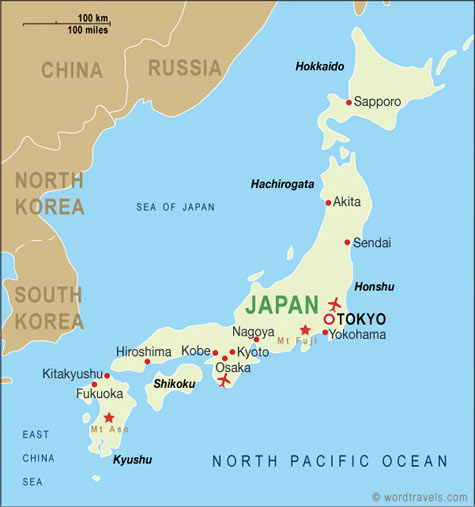

BBC News: Tsunami hits north-eastern Japan after massive quake
A massive earthquake has hit the northeast of Japan triggering a tsunami that has caused extensive damage.
Japan's TV showed cars, ships and even buildings being swept away the Fukushima prefecture, after the 8.8 magnitude earthquake.
Officials said a wave as high as 6m (20ft) could strike the coast.
The quake struck about 250 miles (400km) from Tokyo at a depth of 20 miles, shaking building in the capital for several minutes.
The tremor at 1446 local time (0546 GMT) was followed by a series of powerful aftershocks.
Tuesday, March 8, 2011
Name these 5 middle eastern countries - quiz
The quiz from the Christian Science Monitor

Turkey

Oman

Morocco

Syria
 Libya
Libya

Turkey

Oman

Morocco

Syria
 Libya
Libya
Monday, March 7, 2011
5 Middle Eastern States - Quiz
Well, the quiz is actually from the Christian Science Monitor: Think you know the Middle East? Take our geography quiz.

Jordan

Saudia Arabia

Egypt

Iraq

Iran

Jordan

Saudia Arabia

Egypt

Iraq

Iran
Thursday, March 3, 2011
Rebels reinforce key Libyan oil port in east

Yahoo News: Rebels reinforce key Libyan oil port in east
BREGA, Libya – Rebels reinforced a key oil port Thursday while facing new regime airstrikes in eastern Libya, and thousands of angry mourners buried victims of a counteroffensive by Moammar Gadhafi's forces, shooting guns in the air, shouting "Down with Gadhafi!" and swearing to take vengeance.
Although there have been stirrings of a diplomatic effort to ease the crisis, an opposition spokesman flatly ruled out any negotiations with Gadhafi, saying "his hands are tainted with blood."
President Barack Obama insisted that Gadhafi leave office, declaring he had "lost the legitimacy to lead."
He pledged to hold Gadhafi and his loyalists accountable, saying the U.S. and the entire world were outraged by violence against the rebels, and he lauded U.N. sanctions meant to put international pressure on the longtime ruler.
Signaling he was digging in, Gadhafi's regime apparently has stepped up its recruitment of mercenaries from other African countries, with an official in neighboring Mali saying that 200-300 men have left for Libya in the last week.
The International Criminal Court in the Netherlands said it will investigate Gadhafi, his sons and his inner circle for possible crimes against humanity in the violent crackdown of the 17-day-old uprising that sought to topple the man who has ruled Libya for four decades.
Luis Moreno-Ocampo, the court's top prosecutor, said Gadhafi and several commanders and regime officials had formal or de facto control over forces that attacked protesters, and he promised "no impunity in Libya."
Army units that have joined the rebels fanned out in the oil facilities and port at Brega, armed with machine guns and rocket-propelled grenade launchers and dressed in camouflage army uniforms with checkered keffiyehs. They were backed by at least a dozen pickup trucks with mounted machine guns or towing rocket launchers.
Click image to see photos of protests in Libya
REUTERS/Suhaib Salem
Government warplanes launched a new airstrike on the town Thursday morning, according to witnesses. It was not clear what they targeted, but it was likely an airstrip of the huge oil complex on the Mediterranean coast.
No casualties were reported, and pro-Gadhafi forces withdrew 80 miles (130 kilometers) to the west to another oil port, Ras Lanouf, after their defeat Wednesday by citizen militias from nearby towns and cities.
Despite having little central organization or command, the anti-Gadhafi fighters were able to repel a force of several hundred regime troops that attacked after dawn.
"We are in a position to control the area and we are deploying our forces," a rebel officer in Brega told The Associated Press, speaking on condition of anonymity because he was not authorized to talk to the media.
At least 14 rebel fighters were killed in Wednesday's battle, including Abdul-Salaam Senoussi, whose father, Mohammed, came to Brega to claim his body.
"You know, this is my son," the grieving father said softly after identifying the body. He made a gesture like a pistol and said: "They shot him by plane."
Gadhafi has come under international criticism for firing at his people from warplanes, although his regime denies it.
Also among the dead was 7-year-old Hassan Umran, who was killed when he was caught in the crossfire. His body was at the same Brega morgue as Senoussi's son.
In the opposition stronghold of Benghazi, 140 miles (220 kilometers) northeast of Brega, thousands of mourners chanted "Down with Gadhafi" and fired weapons into the air as they buried three of the dead.
"Our message to Gadhafi is we are coming and we will make Libya free," said one man in the crowd, Sami Mosur. "We will kill him, like he has killed our people here."
Gadhafi has unleashed the bloodiest crackdown of any Arab nation to the recent wave of anti-government protests. Hundreds are known to have been killed, and some estimates top 1,000.
The fighting at Brega halted for now the regime's first counteroffensive on the opposition-held eastern half of the country. It also underlined the deadlock that Libya appears to have fallen into.
Farj Lashrash, a soldier with the opposition, said the rebels had captured 10 pro-Gadhafi soldiers since Wednesday night.
The western gate of the nearby rebel-held town of Ajdabiya, which buried five dead, was reinforced with heavy weaponry — including a tank, four anti-aircraft guns mounted on pickup trucks and four rocket launchers.
Gadhafi's forces seem unable to bring significant strength to dislodge rebels from the territory they hold. But the opposition does not have the capability to go on the offense against Gadhafi's strongholds in the west, including the capital, Tripoli. Its leaders have pleaded for foreign powers to launch airstrikes to help them oust Gadhafi as the United States moves military forces closer to Libyan shores.
The Pentagon on Wednesday tried to play down the idea of using military force in Libya, including a "no-fly zone" that Defense Secretary Robert Gates said would first require attacking Libya's air defenses.
Gadhafi warned the U.S. and other Western powers not to intervene, saying thousands in his country would die and "we will turn Libya into another Vietnam."
A large group of ethnic Tuareg have left from the city of Kidal in northern Mali for Libya in the last week, according to a senior elected official in Mali who spoke on condition of anonymity because he feared government retribution.
Kidal, the base of a rebellion by the Tuareg over the years, is about a two days' drive across the desert to southern Libya. The official, who added that even some of his relatives had gone, said the men were lured by money.
Another man in Mali who is in touch with people en route to Libya said about 40 cars of prospective fighters have crossed into Algeria. They are hesitating about crossing into Libya, fearing that anti-Gadhafi forces were guarding the frontier, the man said. Both spoke on condition of anonymity for fear of reprisal.
Mali is one of the world's poorest countries, where nearly two-thirds of the population earns less than $1 a day.
Oil prices — which have risen to their levels in more than two years — eased below $102 a barrel Thursday on profit-taking and hopes that the conflict in Libya — a member of OPEC — might be resolved by international mediation. Gadhafi ally President Hugo Chavez of Venezuela proposed that his country and a bloc of "friendly" nations mediate, but so far Gadhafi has not responded, and opposition spokesman Mustafa Gheriani ruled out talks.
"We do not accept any negotiations with Col. Gadhafi," Gheriani said. "His hands are tainted with blood and we will not talk to him."
Added Gheriani: "He knows his way to the airport and he can leave."
The attacks on Brega have bolstered the rebels, he said. "We have strong hearts and a cause, and they have nothing," Gheriani added.
Exports from the country with Africa's largest proven oil reserves have all but stopped. Crude production in the southeastern oil fields that feed the facility at Brega has been scaled back because storage facilities there are filling up. Overall, Libyan crude production has dropped from 1.6 million barrels per day, nearly 2 percent of world consumption, to as little as 600,000 barrels per day.
"In the last 24 hours, we had a bit of a panic here," oil company employee Osman Rajab told the AP. "Now they (the rebel army) are trying to control the industrial areas," he said, referring to the oil complex.
At the edge of Brega's massive oil facility, the country's second largest, the rebel army set up a line of defense, with soldiers, four pickup trucks mounted with machine guns and one truck towing a rocket launcher.
For the past week, pro-Gadhafi forces have been focusing on the west, securing Tripoli and trying to take back nearby cities held by rebels using weapons looted from storehouses and backed by allied army units.
Pro-Gadhafi forces succeeded over the weekend in retaking two small towns. But the major western rebel-held cities of Zawiya and Misrata, near Tripoli, have repelled repeated attacks — including new forays against Zawiya on Wednesday.
Zawiya was quiet Thursday, and residents have set up defenses at the city entrances, said resident Alaa al-Zawi, an opposition activist. He said the city has six months' worth of food and water, though it lacks medicine if fighting resumes.
The turmoil in Libya has set off a massive exodus of 180,000 people — mostly foreign workers in Libya — who have fled to the borders, U.N. refugee agency spokeswoman Melissa Fleming told the AP.
At least 5,500 foreign workers were being evacuated from the port of Benghazi. Europe, the United States and the United Nations donated more than $30 million to help the chaotic exodus from the North African nation.
Forces loyal to Gadhafi captured three Dutch marines and their helicopter during a botched evacuation mission Sunday near Sirte, a stronghold of the Libyan leader, the Netherlands' Defense Ministry said.
Tuesday, March 1, 2011
The pirate infested waters of East Africa


The fact that the pirate of Somali have been able to kidnap and murder virtually unopposed for over a decade now is just ridiculous. There's a simple solution. A US C-130 gunship could patrol above Somali waters, and anytime a boat sets out from its shores - blow them out of the water. Sure, the pirates would die, but who cares? They are pirates.
COPENHAGEN, Denmark – A Danish family whose sailboat was seized by pirates in the Indian Ocean wrote on a travel blog that they were in daily contact with anti-piracy forces and had prepared a "piracy plan" in case of an attack.
The family — a couple with three teenage children, aged 12 to 16 — and two adult crew members, also Danes, were captured Thursday by pirates after sending a distress signal, Denmark's government said.
Most hostages captured in the pirate-infested waters off East Africa are professional sailors. Pirates rarely capture families and children, but a 3-year-old boy was aboard a French yacht captured in 2009. His father was killed in the rescue operation by French navy commandos. Two pirates were killed and four French citizens were freed, including the child.
Blog postings chronicling the Danes' round-the-world journey showed they entered the area well aware that an American yacht had been hijacked by pirates just days before but comforted by the presence of counter-piracy forces.
"Of course, we talked quite a lot about it but this is far over thousands of kilometers (miles) away and the Arabian Sea that we sail in is the size of Europe," the family said a Feb. 20 posting on ING jordenrundt.info. ING is the name of their boat.
Two days later, that standoff ended with four Americans being killed by their Somali captors.
It's unclear if the Danish family knew about the deaths of the Americans. Their last posting on Feb. 23 — a day before the hijacking — only said their journey was uneventful and "we have NOT been boarded by pirates."
The blog identified the family as Jan Quist Johansen, his wife Birgit Marie Johansen, their sons Rune and Hjalte and their daughter Naja. They are from Kalundborg, 75 miles (120 kilometers) west of Copenhagen.
The chairman of the Kalundborg yacht club, Ole Meridin Petersen, confirmed their names to The Associated Press. He called them "experienced sailors" and said they were planning to enter the Mediterranean Sea through the Suez canal from the Red Sea.
That route would take the family through the Gulf of Aden, one of the most dangerous waterways in the world in terms of piracy.
"They expected to be home in August," Meridin Petersen told the AP.
Somali pirates have extended their range east and south after increased naval patrols in the Gulf of Aden. They hold more than 660 hostages and some 30 vessels. If a ship's owner is unable to pay the multimillion dollar ransoms the pirates demand, they may keep it and use the boat to stalk other vessels until they run out of supplies or break down.
In the blog, family members wrote they felt reassured as they saw overflights by counter-piracy patrol planes and had daily contact with naval authorities.
"It is reassuring that they look after us," a Feb. 20 blog post said.
A day earlier, the family blogged they had drawn up "a piracy plan for who does what if we are attacked." They were also sending daily position and status updates to the British Royal Navy's UK Maritime Trade Operations, which acts as a liaison for ships traveling through waters threatened by pirates.
The Johansens had been reporting the position of their yacht daily via e-mail since Feb. 17, said Wing Cmdr. Paddy O'Kennedy, a spokesman for the European Union's anti-piracy force.
Denmark's Foreign Ministry on Tuesday advised citizens against traveling in sailboats in the Gulf of Aden, the Arabian Sea and the northwestern Indian Ocean. Ministry officials said they confirmed the Danish boat was seized by pirates and were doing "everything in our power" to help the Danes.
Subscribe to:
Posts (Atom)